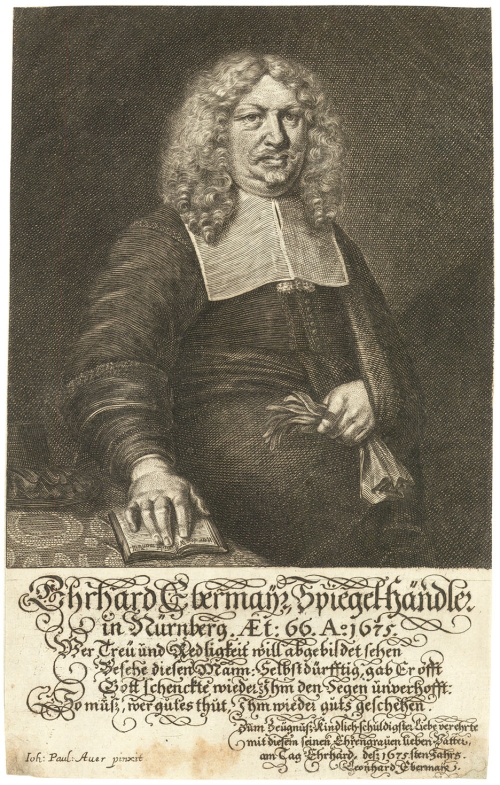
Johann Paul Auer (1636–1687) was a foundational figure in the development of late German Baroque painting, particularly within the scholarly and administrative hub of Nuremberg. His career began under the tutelage of Georg Christoph Eimmart the Elder, but his stylistic maturity was forged during a period of extensive travel through France and Italy. His five-year residency in Rome proved transformative; there, he absorbed the dramatic lighting and structural grandeur of the High Baroque, allowing him to transition from the meticulous tradition of German craftsmanship to a more expansive, international style.
Upon his return to Nuremberg in 1670, Auer established himself as the premier portraitist for the city's patrician class and intellectual elite. His work is characterized by a profound sense of gravity and social presence, utilizing a formal language that emphasized the professional dignity of his sitters. Because of his precise drafting, his paintings were frequently selected by the periods master engravers—including Jacob von Sandrart and Johann Friedrich Leonard—to be reproduced as copperplate frontispieces for major academic and historical publications. Beyond his individual commissions, Auer held a leadership role at the Nuremberg Academy of Fine Arts, where he was instrumental in standardizing the technical rigor that defines 17th-century Franconian art.
While much of his output remains in private European collections, several significant works and their engraved counterparts are held in major public repositories. His 1686 Portrait of Andreas Georg Paumgartner is a definitive late-career work held in the LWL-Museum fur Kunst und Kultur in Munster, with the corresponding engraving being a centerpiece at the Herzog August Library in Wolfenbuttel. The German National Museum in Nuremberg holds the 1672 Portrait of Paul Volckamer, a primary example of his sober, patrician style. Additionally, his portraits of Friedrich Volckamer and various historical and allegorical compositions are preserved within the Nuremberg Municipal Museums and the archives of the Nuremberg Academy of Fine Arts.
SHARE



 Login / Register
 Basket