Henry Pierce Bone was an English painter and enamelist born in London, the son of the prominent Royal Academician Henry Bone. He received his training within his father's studio, developing a foundation in the technical precision required for enamel work while initially pursuing a career as a painter of historical, mythological, and biblical subjects in oil. Between 1799 and 1833, he was a frequent exhibitor at the Royal Academy and the British Institution, gaining a reputation for his versatile handling of scale and color.
Following his father’s death, Bone increasingly focused on the difficult medium of enamel, where he achieved remarkable success by translating the texture and tonal depth of large-scale oil paintings into small, permanent works on copper. This expertise secured him successive royal appointments as the Enamel Painter to King William IV, Queen Adelaide, and Queen Victoria.
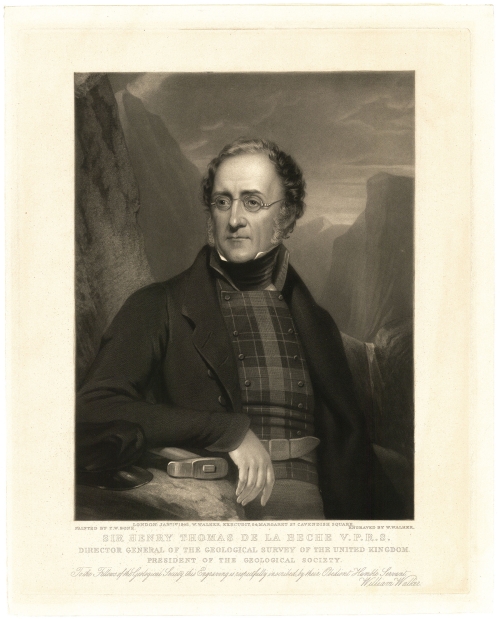
His contribution to the iconography of Victorian science is best exemplified by his portrait of Sir Henry Thomas De la Beche. Bone executed the original watercolor of the geologist, which he exhibited at the Royal Academy in 1847. This work broke from the traditional, static indoor portraiture of the era by depicting De la Beche in a mountainous landscape with a geological hammer, emphasizing the subject's active role in field research. This specific likeness was selected by the engraver William Walker for his 1848 mezzotint. Bone’s works are preserved today in the National Portrait Gallery, the British Museum, and the Victoria and Albert Museum.
SHARE



 Login / Register
 Basket