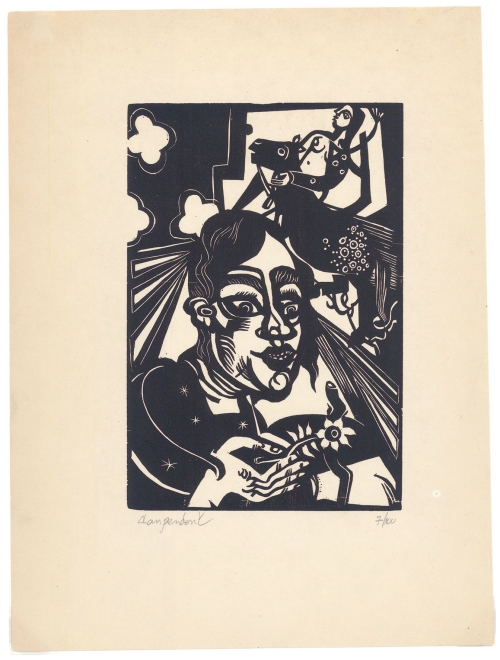
1889 - 1957
Heinrich Campendonk was a German painter, printmaker, and designer whose distinctive synthesis of Expressionism, Cubism, and Bavarian folk art placed him among the artists associated with Der Blaue Reiter. Born in Krefeld on 3 November 1889, he studied at the Krefeld School of Arts and Crafts under Johan Thorn-Prikker. Thorn-Prikker’s interest in Symbolism, medieval art, and the decorative possibilities of line and color exerted an important influence on Campendonk’s early development.
In 1911 Campendonk moved to Sindelsdorf in Upper Bavaria, where he became closely associated with Franz Marc and the circle surrounding Der Blaue Reiter. His participation in the movement’s first exhibition in Munich that year established his position within the German avant-garde. During this period his work developed a highly individual vocabulary of simplified forms, luminous color, flattened spatial structures, and emphatic contours. Animals, particularly horses, cattle, goats, and deer, became recurring subjects, treated not as objects of naturalistic observation but as participants in an imaginative and spiritualized vision of nature.
Campendonk began producing prints in 1912 and soon became an important figure in the development of German Expressionist graphic art. His printmaking was concentrated principally in the woodcut, a medium particularly well suited to his strongly linear and simplified manner. His approximately seventy-seven known prints include some of the most compelling graphic interpretations of his pastoral and animal imagery. The emphatic black-and-white contrasts of the woodcut allowed him to reduce forms to essential contours while retaining the rhythmic and symbolic qualities characteristic of his paintings. His prints appeared in important Expressionist publications and portfolios, including Der Sturm, Das Holzschnittbuch, and Die Schaffenden.
The First World War interrupted this development. Campendonk was drafted in 1915 but discharged because of ill health. He subsequently settled at Seeshaupt on Lake Starnberg. The death of Franz Marc in 1916 was a profound personal and artistic loss. Campendonk’s work of the later 1910s became increasingly contemplative, with human and animal figures integrated into visionary landscapes that emphasize the interdependence of living forms rather than conventional distinctions between figure and setting.



 Login / Register
 Basket