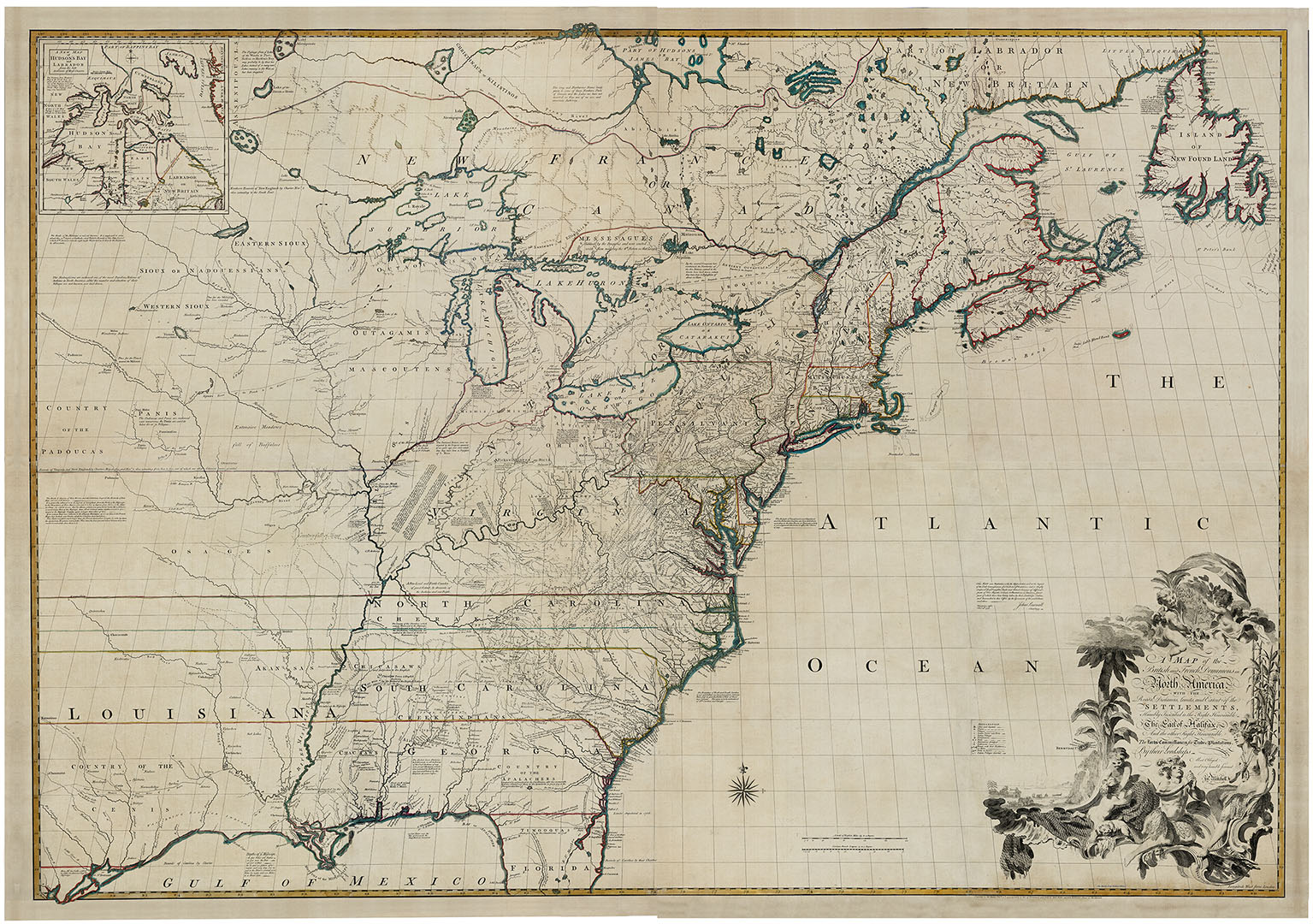
Price: $1,000.00
SKU: 62631
ARTIST: Dr. John Mitchell
PUBLISHER: Publish'd by the Author Febry. 13th 1755 according to Act of Parliament, and Sold by And: Miller opposite Katherine Street in the Strand. London.
MEDIUM: Digital reproduction after the original copper plate engraving.
DATE: 1755
EDITION SIZE: Eight sheets, each measuring 26 1/4 x 19" - overall size 56 x 76" Framed size 61 1/2 x 85"
DESCRIPTION: Title continues "Humbly Inscribed to the Right Honourable The Earl of Halifax, And the other Right Honourable The Lords Commissioners for Trade & Plan." <BR><BR>Mitchell’s map of the United States is widely regarded as the most important map in American History. Prepared on the eve of the French & Indian War, it was the second large format map of North America printed by the British and included the best up-to-date information of the region. Over the next 200 years, it would play a significant role in the resolution of every significant boundary dispute involving the northern border of the then British Colonies and later the United States. It was also the map-of-record at the birth of the United States and which continued in this role through several decades in the early life of the country. <BR><BR>John Mitchell (1711-1768) was a remarkable and learned gentleman. During his life he was an accomplished physician, botanist, chemist, biologist, and surveyor. He was born in Virginia and later attended the University of Edinburgh where he received his medical degree. He returned to Virginia settling in Urbanna. For health reasons, Mitchell left Virginia, and settled in London in 1746. In 1748 he was invited to join the Royal Society. It is at this society where he became acquainted with met members of the Board of Trade and Plantations. In 1750 the president of the Board, Earl of Halifax asked him, to prepare a map of the British Colonies in North America. The object of this map was to provide graphic evidence of the maximum extent of the British territorial claims against those of the French who had been encroaching on the territories claimed by the English. Mitchell was given access to the extensive collection of manuscript maps and geographical reports in the archives of the British Board of Trade and British Admiralty. <BR><BR>Mitchell’s map was first issued in February, 1755 with the approval of and at the request of the British Government. It was dedicated to the Earl of Halifax and was endorsed by John Pownall, Secretary of the Lords Commissioners for Trade and Plantations. True to his instructions, Mitchell enhanced the British claims over those of the French. He extended the boundaries of Virginia, the Carolinas, and Georgia westward across the Mississippi River and furthered British claims in the Ohio Valley. Politics aside, this map was a major step forward in the cartography of North America. It also turned out to be one of the most significant maps in American history. <BR><BR>In its rich history it was the map of choice used during the Treaty of Paris peace negotiations between Great Britain and her former American colonies in 1783. To get even a partial sense of the historic uses to which the map was put, we quote Martin (as quoted by Ristow, pp.104-05): "It is thought to have been in use in the British House of Commons during the debate on the Quebec Act of 1774; it is known to have hung in the halls of Congress in 1802 and several times subsequently. It was used ... in the discussions of British land grants in the Ohio and Mississippi valleys, and in scores of controversies involving the boundary lines existing at the time of its publication. Great Britain and the United States agreed to its official status in the Convention of September 29, 1827.... it exerted substantial influence in the negotiation and ratification of the Webster-Ashburton Treaty of 1842, and serious argument was based upon it by Great Britain before the Court of Arbitration at The Hague in 1910 in connection with the North Atlantic Coast Fisheries Arbitration. It was submitted in evidence before the Law Lords of the British Privy Council in 1926 in the appeal of Price Brothers & Company, Limited, from a judgment of the supreme court of Canada, and in 1926-27 in the Canada-Newfoundland (Labrador) boundary case. It was used as evidence before the Supreme Court of the United States in the Wisconsin-Michigan boundary case, in 1926-27 in the Great Lakes level case, and in 1932 in the New Jersey-Delaware boundary case." <BR><BR>Even Thomas Jefferson recommended to Nicholas King that he use Mitchell's map in preparing a new map for Meriwether Lewis, saying: "it was made with great care we know from what is laid down in those western parts with which we have lately become acquainted." The importance of this map in regards to the history of the United States can not be understated. <BR><BR>From 1755 to 1791 there were twenty-one editions, states and/or impressions produced: seven in England; ten in France; two in Holland; and two in Italy. This impression is a first state, first issue, issued in England and published by Mitchell himself. The first state is rarely seen on the market.
ADDITIONAL INFO:
CONDITION: Fine condition.
REFERENCE: Stephenson, R. W. "A la Carte" p.109, first edition, first impression; Schwartz & Ehrenberg, Mapping of America, p. 159.



 Login / Register
 Basket