Price: $250.00
SKU: 94715
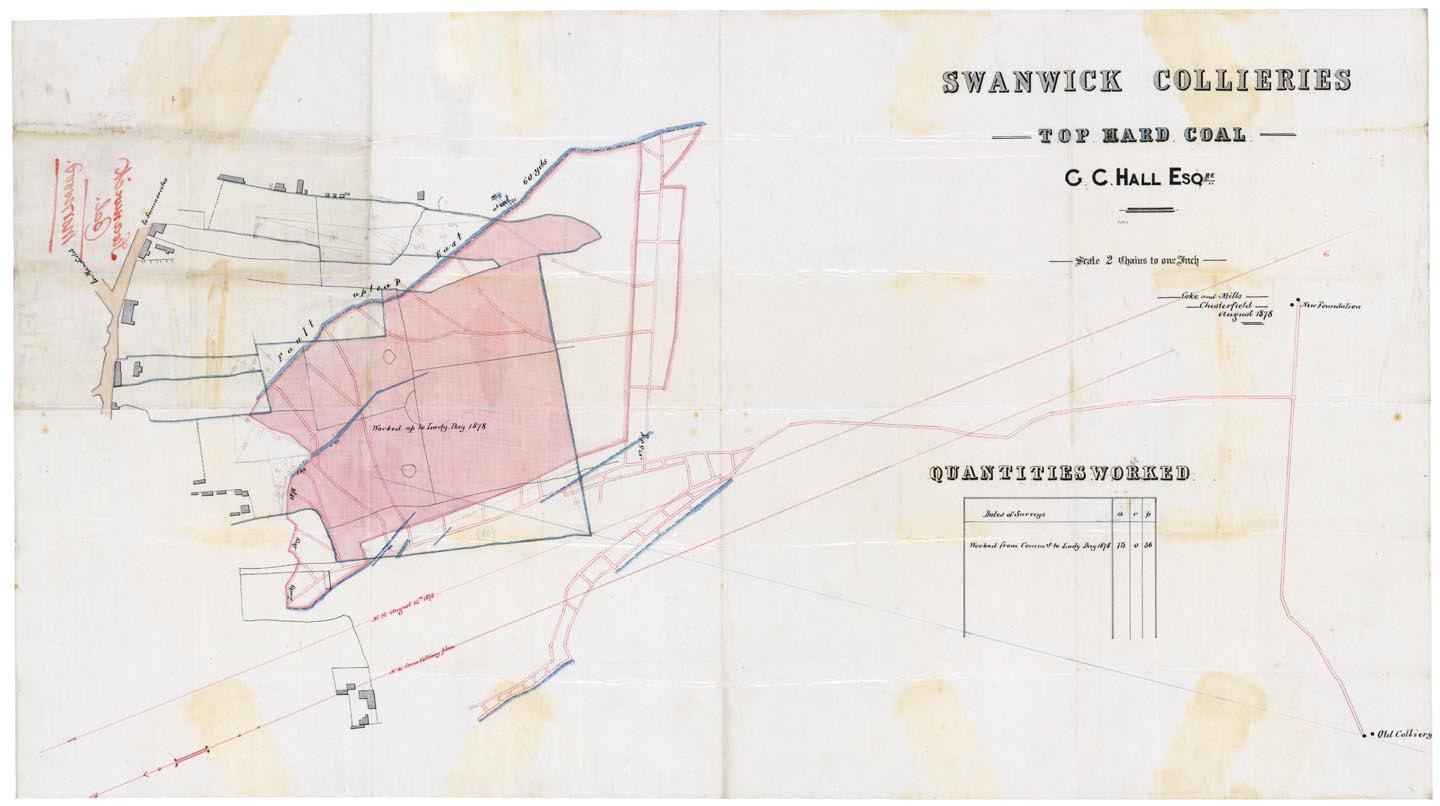
MEDIUM: Manuscript, pen & ink and wash drawing on drafting parchment.
DATE: 1878.
EDITION SIZE: Sheet size 19 1/4 x 34 1/2" (48.9 x 87.6 cm)
DESCRIPTION: This map shows the layout of the grounds of the Swanwick Collieries, located in the English county of Derbyshire. The following information was taken from a webpage of the Somercotes Local Historical Scoiety. “Swanwick Collieries. Mining at Swanwick and around the area south west of Alfreton had been taking place almost since the locality had been settled. The Turner family of Swanwick originally owned much of the mineral rights and are recorded sinking a coal pit in 1636. In 1789, George Morewood, Lord of the Manor of Alfreton, purchased this pit and the mineral rights from the Trustees of the estate of Charles Turner, who had died in 1736. The Turner estate had been held in trust under the conditions of Charles Turner’s Last Will & Testament, under which the Executors established the Swanwick Coal Company in order to help administrate the estate.<br><br>In 1816, following the Inclosures Act, over 263 acres of land in the district of Alfreton was enclosed, and the Palmer-Morewood family started to mine on what was then called Alfreton Common. Both Palmer-Morewood and the Swanwick Colliery Company sank several shafts in the area around what would become the Swanwick Colliery complex. <br><br> From various sources, the dates (in some cases approximate) for the various shafts at the complex can be determined as below: <br><br> Swanwick Engine – first sunk in 1833<br><br> Swanwick Old – first sunk in 1851 to the Top Hard Seam. The shaft was 140 yards deep and during its life would exploit some eight or nine seams. At one point it changed its name to the Lilley Street colliery (after the Lilley Street Farm area) and finally closed in 1936. <br><br> White’s Lane – first sunk in 1853 to the Waterloo Seam, and then extended in 1867 to the Deep Hard Seam. The Waterloo Sean was abandoned in 1889. White’s Lane would be used as a secondary access shaft for the Swanwick New shaft.<br><br> Swanwick Deep – first sunk in 1856 to the Top Hard Seam and then extended in 1867 down to the Deep Hard Seam at a depth of 295 yards. <br><br> Swanwick Common – first sunk in 1903 to the Waterloo Seam. <br><br> Swanwick New - first sunk in 1914 this shaft went through all of the seams down to 43 yards below the Black Shale. The Black Shale Seam was mined at a depth of approximately 390 yards. This seam was mined until 1968, when Swanwick Colliery closed.<br><br> The coal exploited at Swanwick was considered to be of the very best quality.
ADDITIONAL INFO:
CONDITION: Good condition.
REFERENCE:



 Login / Register
 Basket