Price: SOLD
SKU: 100390
ARTIST: Henry Walling
PUBLISHER: Published by S. D. Tilden. New York.
MEDIUM: Stone engraving
DATE: 1860.
EDITION SIZE: Segmented wall map. 64 x 64 3/4" (162.7 x 164.5 cm)
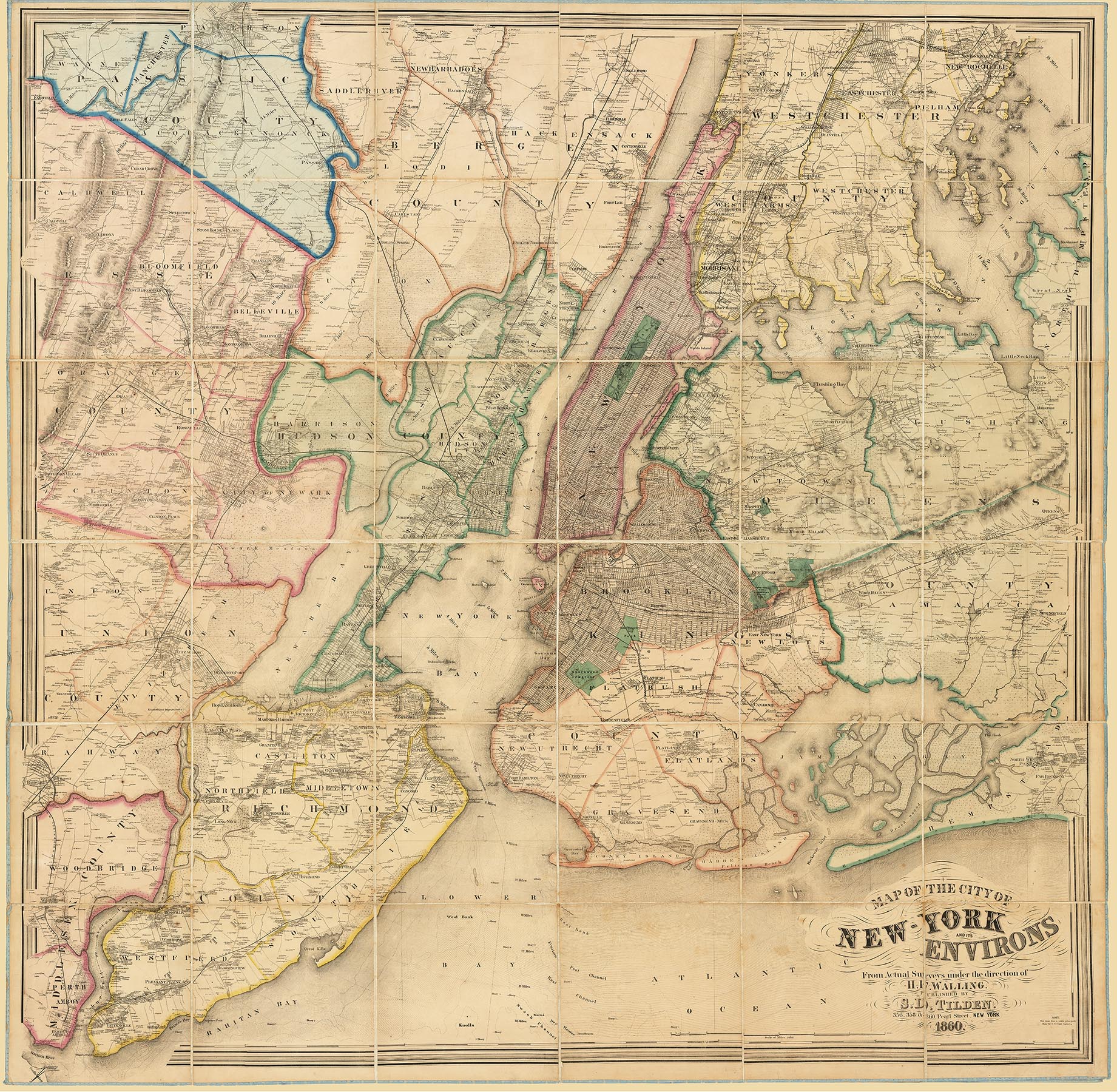
DESCRIPTION: A spectacular, information-rich, and very scarce 1860 map of the New York metropolitan area by Henry Francis Walling, one of the giants of 19th-century American mapmaking.<br><br> The map depicts a roughly 14-mile-square area centered on New York City Hall in Lower Manhattan. At the time New York City itself was confined to Manhattan Island, with a population just over 800,000. But the city was already an economic and cultural powerhouse, its growth fueled by the completion of the Erie Canal in 1825, the proliferation of rail lines, the completion of the Croton Aqueduct in 1848, and the arrival of tens of thousands of Irish immigrants. By choosing to place City Hall in the center of the map, Walling was emphasizing that the city already was in many ways the region’s beating heart, pumping people and goods on the great network of railroads running in and out of it in all directions. <br><br> Of course, New York City is not the only story here. The map shows that many of the same factors were driving development across the East River in Brooklyn, at the time America’s third-largest city, and across the Hudson in Hoboken, Jersey City and the other cities of Bergen County. Further afield, the railroad was bringing growth to smaller cities like those along the New York & New Haven line in Westchester County and the New Jersey Line in northeastern New Jersey. All the same, it’s striking to see just how much open space remained so close to the city, particularly in outlying areas of Kings and Queens Counties that today are densely populated. <br><br> Walling manages to cram an enormous amount of information into the map, though sometimes at the expense of legibility and with relatively little attention to the region’s natural topography (For instance, neither the rough terrain of Upper Manhattan or the long ridge of Brooklyn Heights are shown.) For Walling, as for us moderns, the real landscape of New York is the built landscape of streets, rail lines, piers, buildings, and homes. Even in the less densely populated areas, he takes advantage of the elbow room to identify by name thousands of residences; factories, mills, hotels, and other businesses; hospitals, churches,s and schools; cemeteries and parks; and even the several forts and batteries then considered vital to protect the Hudson River and its approaches.<br><br> Being a folding segmented case map, as opposed to a varnished roller map, the condition of this map is exceptionally good. The hand coloring is original and bright.<br><br>
ADDITIONAL INFO: Framed. (Picture can be sent of the overall framed piece)
CONDITION: Very good condition. Original hand coloring.
REFERENCE:



 Login / Register
 Basket