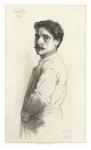
Charles Bellay
Charles Paul Alphonse Bellay was a French etcher and illustrator active in Paris during the height of the nineteenth century etching revival. Born in 1826, he worked within the academic tradition that shaped the generation after 1850, producing portraits and interpretive plates that reflect careful draftsmanship and controlled line work. Although his early training is not fully documented, Bellay’s approach suggests the influence of studio practice in Paris, with an emphasis on likeness, direct etching, and the expressive use of drypoint.
Bellay’s career developed alongside the rise of the Societe Francaise de Gravure, founded in 1868 to encourage and distribute original etchings. His plates were published through this organisation, often issued first in an unlettered state for personal exchange and then later in a lettered state for the society’s subscribers. The 1876 portrait of Paul Baudry is a key example: first etched with a personal dedication to the sitter, then issued in 1886 as part of the society’s formal program. This pattern reflects Bellay’s place within the close artistic networks of Paris, where printed portraits served as both aesthetic statements and a record of professional relationships.
Today, Bellay’s work is recorded in the Inventaire du Fonds Francais apres 1800 (IFF) at the Bibliotheque Nationale de France, which catalogues his known plates and establishes their sequence of states. While not a widely recognised figure in the revival compared to Bracquemond or Legros, Bellay’s portrait etchings preserve the human dimension of the movement: artists depicting their peers with intimacy, respect, and technical refinement. His prints provide insight into the collaborative culture of nineteenth century Paris, and into the role of the etcher as both image maker and participant in a shared artistic community.



 Login / Register
 Basket