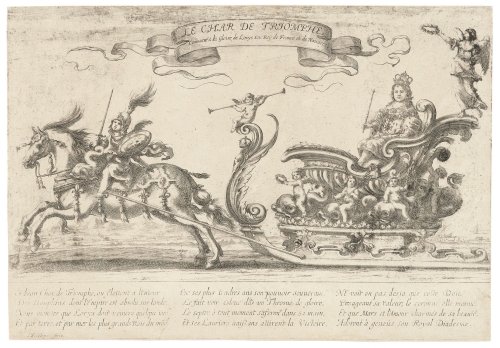
Francois Collignon (c. 1610–1687) was a 17th-century French engraver, print-seller, and publisher active in Paris and Rome, recognized for his expansive output of reproductive prints, architectural views, and publishing ventures.
Born in Nancy, Collignon trained in the studio of Jacques Callot before traveling to Augsburg and eventually settling in Italy. After working in Paris alongside Israel Henriet during the 1630s and 1640s, he permanently established his workshop and publishing house in Rome. His artistic and commercial output encompassed reproductive engravings, topographical landscapes, ceremonial events, and decorative designs.
Collignon became a prominent figure in the Roman print trade, publishing works after major contemporary Italian and French masters, including Pietro da Cortona, Nicolas Poussin, Charles Le Brun, Simon Vouet, Pietro Testa, and Jean Le Pautre. Following his death in Rome, his substantial stock of copperplates and prints was acquired by the Flemish publisher Arnold van Westerhout.
His work is represented in major public collections, including the British Museum in London, the Metropolitan Museum of Art in New York, and the Bibliotheque Nationale de France in Paris.
References
Benezit, Emmanuel. Dictionary of Artists. Vol. 3. Paris: Grund, 2006.
Kuhnminch, Jacques. "Un marchand d'estampes a Rome au XVIIe siecle: Francois Collignon." Bulletin de la Societe de l'Histoire de l'Art Francais (1978): 79–100.
Meaume, Edouard. Recherches sur la vie et les ouvrages de Jacques Callot. Paris: Jules Renouard, 1860.
Meyer, Veronique. L'estampe francaise du XVIIe siecle. Paris: Bibliotheque Nationale de France, 2002.



 Login / Register
 Basket