Price: $2,350.00
SKU: 64715
ARTIST: Mark Catesby
PUBLISHER: London: Printed at the expense of Mark Catesby, and sold by W. Innys, R. Manby, and Mr. Hauksbee.
MEDIUM: Engraving handcolored,
DATE: 1731
SIZE: Paper size 20 3/4 x 14 7/16" (527 x 367 mm).
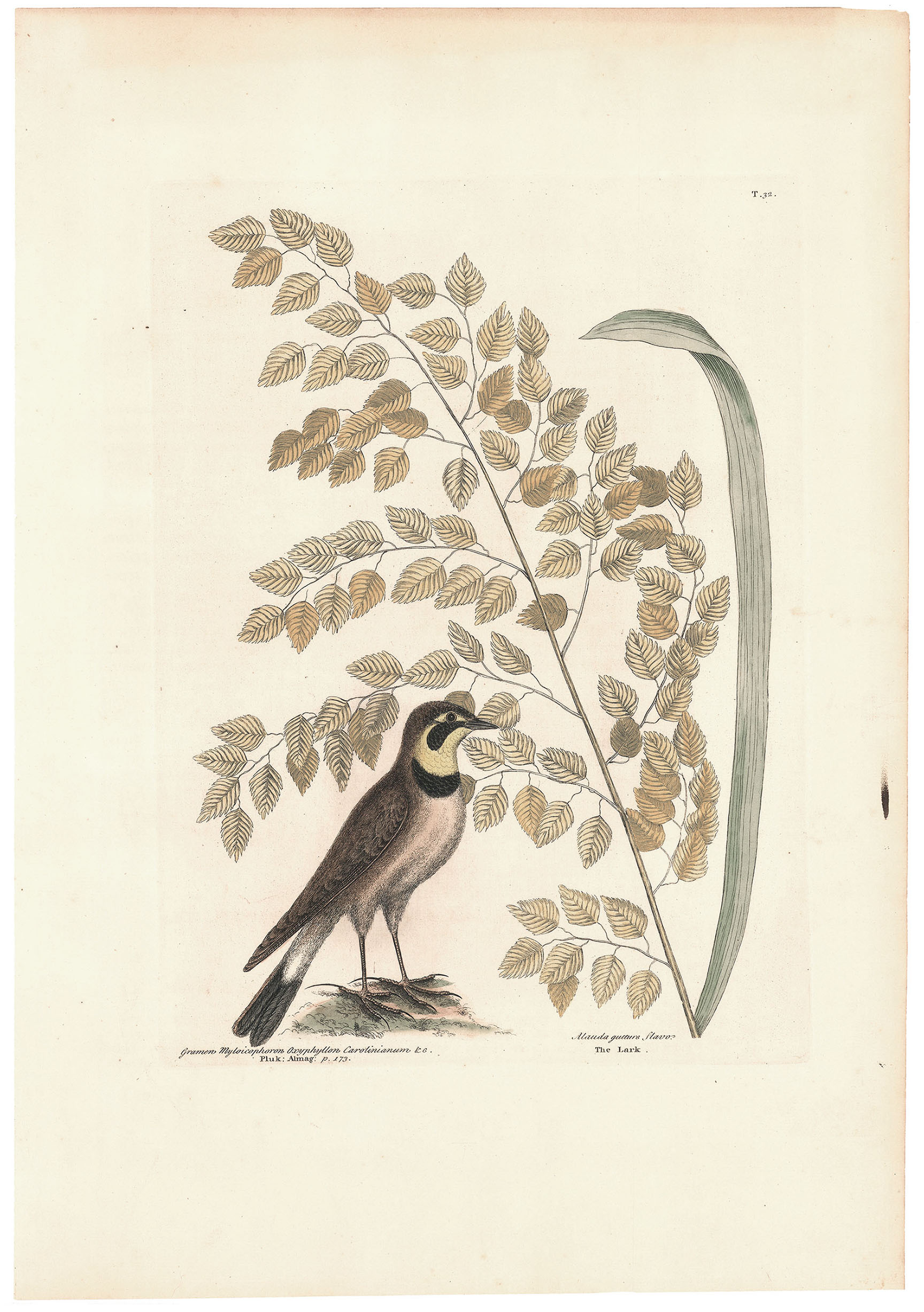
DESCRIPTION: This hand colored engraving appeared in the first edition of Mark Catesby's The Natural History of Carolina, Florida, and the Bahama Islands, first published in London in 1731. Catesby's work was the first major illustrated study of the plants and animals of southeastern North America and the Bahamas. Much of the material was gathered during his travels through the region, where he spent several years observing and documenting its natural history. Catesby prepared the illustrations himself and etched the copperplates, frequently placing birds alongside plants he encountered during his travels.<br><br> Depicted here is the Lark, now known as the Horned Lark (Eremophila alpestris), standing beside a stalk of Sea Oats. Catesby described the bird's yellow throat, black facial markings, and the crescent-shaped patch of black feathers across its breast. He observed that these birds appeared in Virginia and Carolina during the colder months, arriving from the north in large flocks before departing again in early spring. Catesby compared them to the European Skylark but admitted that he could not determine whether they sang in flight like their European relatives, since he had only encountered them during the winter. He noted that they frequented the sandy hills along the Carolina coastline, where they fed on the seeds of Sea Oats scattered across the sand.<br><br> The accompanying plant is Sea Oats (Uniola paniculata), a tall perennial grass native to the Atlantic and Gulf coasts of North America. Catesby recorded finding it growing on sand dunes so close to the ocean that high tides sometimes reached its roots. He estimated that the plants typically grew four to five feet tall. Sea Oats are particularly important to coastal environments because their extensive root systems help hold shifting sand in place, protecting dunes from erosion. Their distinctive drooping seed heads resemble those of cultivated oats, giving the plant its common name. Catesby's decision to illustrate the two species together reflects his firsthand observations of their relationship along the Carolina coast.<br><br>
ADDITIONAL INFO:
CONDITION: Good condition save for small ink smudge in outer right margin. Original hand color.
REFERENCE:



 Login / Register
 Basket