Price: SOLD
SKU: 67717
ARTIST: Amos Doolittle
PUBLISHER: Published & Sold by Shelton & Kensett Cheshire; and Root & Atwater New-Haven Connec. Sept 1st 1815.
MEDIUM: Engraving,
DATE: 1815
EDITION SIZE: Plate size 19 x 14 3/4" (48.2 x 37.5 cm).
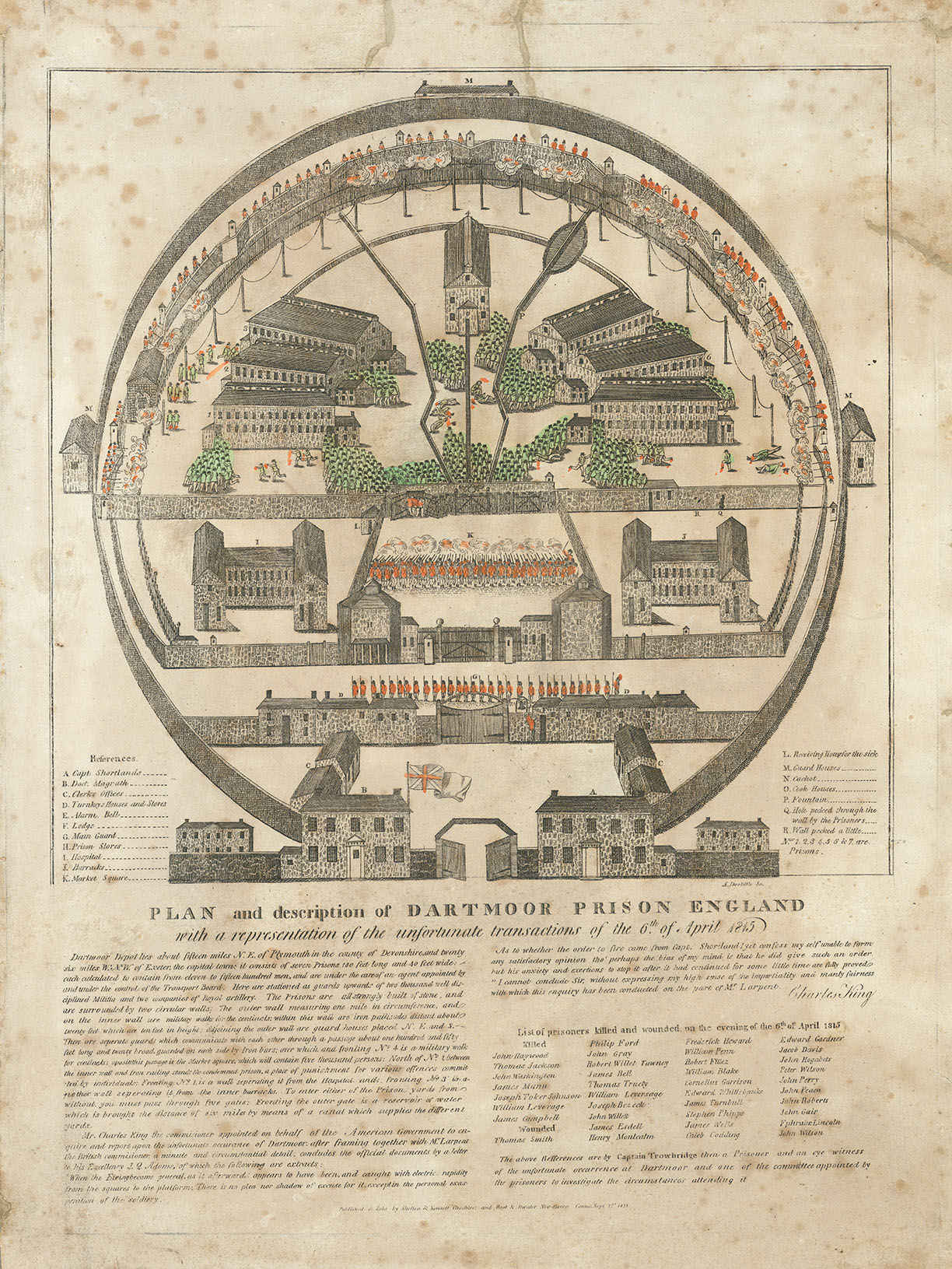
DESCRIPTION: Engraved by Amos Doolittle. One of only four known impressions of this compelling image of the “Dartmoor Massacre.” <BR> During the war Dartmoor Prison in Devon housed thousands of captured American sailors along with an even greater number of Frenchmen captured in the long fight against Napolean. Though the Treaty of Ghent ending the war was ratified in February 1815, months later the Americans were still awaiting repatriation. Conditions were cramped and the food execrable, and hundreds had died and continued to die of disease. Making things worse, the prison’s commandant Captain Shortland seems to have been a short-tempered alcoholic, and relations between captors and captured were tense. <BR> The massacre occurred on April 6, 1815, apparently when Captain Shortland ordered his men to open fire on the prisoners following the discovery of a hole in one of the prison walls. Several Americans were killed and perhaps 40-60 wounded. Some accounts suggest that Shortland had panicked, thinking an escape was imminent, others that the shooting was premediated and that the hole was merely a pretext. Ironically, it may have been made by young boys trying to recover a lost ball. <BR> This engraved broadside by Amos Doolittle is the rarest of the many published depictions of the massacre. The image is striking and brutal, depicting the prison’s concentric walls and fences surrounding an inner yard containing prison barracks radiating from a central point, with access gates, administration buildings, and housing for the officers and men of the guard in the foreground. Arrayed around the walls and fences are over a hundred redcoats, all firing into a crowd of prisoners in the courtyard. A table identifies many of the locations shown, and a long text at the base describes the prison and reprints part of the report of Charles King, the American commissioner appointed to investigate the event.
ADDITIONAL INFO:
CONDITION: Toned and foxed, with some mended tears and marginal chipping.
REFERENCE: Brien, A Comprehensive List of Engravings in Chronological Order by Amos Doolittle (1754-1832), citing examples at the Franklin D. Roosevelt Library and New Haven Colony Historical Society. AAS, Engravings, #3439 but citing no known examples. Stauff



 Login / Register
 Basket