Price: $2,000.00
SKU: 78377
ARTIST: Mark Catesby
PUBLISHER: London: Printed for Benjamin White, at Horace's Head, in Fleet-Street.
MEDIUM: Handcolored engraving,
DATE: 1771.
SIZE: Paper size 13 1/4 x 19" (33.6 x 48.2 cm)
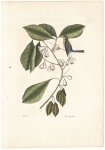
DESCRIPTION: This hand colored engraving appeared in the third edition of Mark Catesby's The Natural History of Carolina, Florida, and the Bahama Islands, published in London by Benjamin White in 1771. Originally published between 1731 and 1747, Catesby's work was the first major illustrated study of the plants and animals of southeastern North America and the Bahamas. Much of the material was gathered during his travels through the region, where he spent several years observing and documenting its natural history. Catesby prepared the illustrations himself and etched the copperplates, which continued to be used in subsequent editions. The third edition was revised by George Edwards and included an updated index based on the classification system of Carl Linnaeus. This engraving is Plate 14 from the first volume.<br><br> Depicted here is the Rice-Bird, now commonly known as the Bobolink (Dolichonyx oryzivorus), illustrated in both its male and female plumage alongside a stalk of cultivated rice (Oryza sativa). In his accompanying description, Catesby discussed the enormous flocks of these birds that descended upon the rice plantations of Carolina each September, when the grain was still soft and milky. He recalled an incident in 1724 when a plantation owner near the Ashley River lost so much of his forty-acre rice crop to the birds that he questioned whether the remainder was worth harvesting. Despite the damage they caused, Catesby noted that the birds were considered a great delicacy in Carolina. He observed that they arrived relatively lean but became so fat after feeding on the rice that they could barely fly, sometimes breaking apart when they fell to the ground after being shot.<br><br> Catesby was particularly interested in the birds' seasonal movements. He believed that the enormous flocks arriving in September consisted entirely of females, a conclusion he reached after examining numerous specimens prepared for eating. He contrasted this with their spring appearance, when both sexes could be readily distinguished. Modern ornithology has established that male Bobolinks lose their distinctive black and yellow breeding plumage in late summer, making them resemble females. Catesby also recalled an experience in September 1725, when he was lying aboard a sloop near Andros Island in the Bahamas. For three consecutive nights, he heard flocks of Rice-Birds passing overhead and recognized their calls. He believed that they were traveling between Cuba and Carolina in search of ripening rice. His observations contributed to his later interest in bird migration, a subject he addressed in a paper presented to the Royal Society in 1747. The plate also records the close relationship between the birds and rice cultivation, which had become an important part of Carolina's colonial economy and depended heavily on the agricultural knowledge and labor of enslaved Africans.<br><br>
ADDITIONAL INFO:
CONDITION: Good condition with full original color, save for mild toning.
REFERENCE:



 Login / Register
 Basket