Price: $1,000.00
SKU: 87630
ARTIST: Mark Catesby
PUBLISHER: London: Printed for C. Marsh, in Round Court in the Strand; T. Wilcox, over-against the New Church, in the Strand; and B. Stichall in Clare-Court, MDCCLIV.
MEDIUM: Engraving handcolored,
DATE: 1754
EDITION: Third Edition.
SIZE: Paper size 14 7/16 x 20 3/4" (366 x 526 mm).
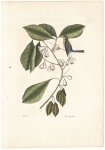
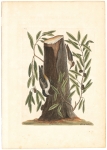
DESCRIPTION: This hand colored engraving appeared in the second edition of Mark Catesby's The Natural History of Carolina, Florida, and the Bahama Islands, published in London by Charles Marsh, Thomas Wilcox, and Benjamin Stichall in 1754. Originally published between 1731 and 1747, Catesby's work was the first major illustrated study of the plants and animals of southeastern North America and the Bahamas. Much of the material was gathered during his travels through the region, where he spent several years observing and documenting its natural history. Catesby prepared the illustrations himself and etched the copperplates, which continued to be used in subsequent editions. The second edition was published after Catesby's death in 1749 and revised by the English naturalist George Edwards. This engraving is Plate 86 from the first volume.<br><br> Depicted here is the Great Booby, a large seabird which Catesby described as being approximately the size of a goose, with a thick neck, a bill nearly six inches long, and a wingspan of six feet. He was particularly interested in the unusual construction of its bill, claiming that the upper portion could be raised independently of the lower jaw. Catesby recorded these birds along the rivers and coast of Florida, where he observed them diving into the water in pursuit of fish. He also mentioned finding several specimens injured or dead along the shore, which he believed may have been the result of encounters with sharks or other large predatory fish. Although Catesby named the bird the Great Booby because of its resemblance to other boobies, subsequent naturalists have identified the bird illustrated here as an immature Northern Gannet (Morus bassanus).<br><br> The accompanying plant, identified by Catesby as Thymelaea foliis obtusis, is now recognized as the White Mangrove (Laguncularia racemosa). In his description, Catesby noted that the shrub grew approximately eight to ten feet high, with smooth, rounded leaves and small white flowers showing a faint reddish color inside. He observed the plant growing along the rocky shores of several Bahamian islands, often among sedges and other coastal vegetation. Mangroves are particularly well adapted to coastal environments, where their root systems help stabilize shorelines and provide shelter for numerous marine species. Catesby's original description of the bird is particularly interesting for its combination of physical observation and speculation about its behavior. Modern research by botanist James L. Reveal has since clarified the identification of both the bird and plant, illustrating how scientific understanding has developed since Catesby's eighteenth-century observations.<br><br>
ADDITIONAL INFO: Printed on watermarked paper.
CONDITION: Good condition.
REFERENCE:



 Login / Register
 Basket