Price: $600.00
SKU: 88196
ARTIST: Mark Catesby
PUBLISHER: London: Printed for C. Marsh, in Round Court in the Strand; T. Wilcox, over-against the New Church, in the Strand; and B. Stichall in Clare-Court, MDCCLIV.
MEDIUM: Engraving handcolored,
DATE: 1754
EDITION: Second Edition.
SIZE: Paper size 14 1/4 x 20 7/8" (36.1 x 52.9 cm).
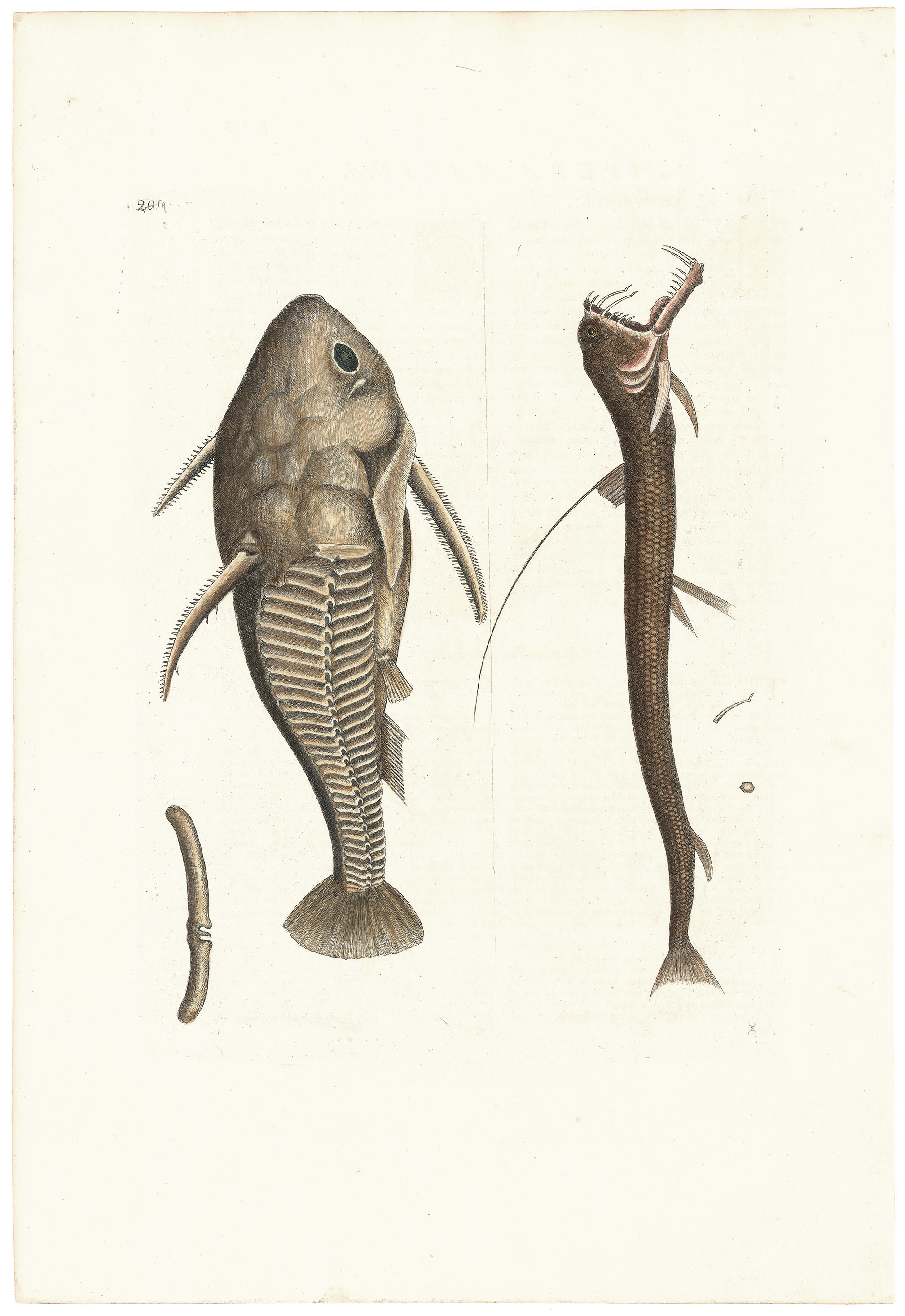
DESCRIPTION: This hand colored engraving appeared in Mark Catesby's The Natural History of Carolina, Florida, and the Bahama Islands, originally published in London between 1731 and 1747. Catesby's work was the first major illustrated study of the plants and animals of southeastern North America and the Bahamas. Much of the material was gathered during his travels through the region, although he also made use of specimens sent to England by other naturalists and collectors. Catesby prepared the illustrations himself and etched the copperplates, which continued to be used in subsequent editions. This engraving is Plate 19 from the appendix to the second volume, first published in 1747, and depicts two rather unusual species of fish.<br><br> The larger, elongated fish is the Viper-Mouth, now identified as Sloane's Viperfish (Chauliodus sloani), a deep sea species found throughout tropical and temperate waters. In his accompanying description, Catesby recorded a specimen measuring eighteen inches long, with six fins and a remarkably large mouth filled with long, sharp teeth. He was particularly interested in the arrangement of the teeth, noting that four were so long that they extended outside the mouth even when it was closed. Catesby described the specimen as brown, resembling the color of a common viper, although he had been told that living examples were green. The fish had been sent to him from Gibraltar, where it was reportedly caught in the harbor, and was subsequently preserved in the collection of Sir Hans Sloane. Modern research has shown that these fish inhabit considerable ocean depths, generally remaining in deeper waters during the day and sometimes moving toward the surface at night to feed. They also possess light producing organs along their bodies, an adaptation to life in the deep ocean.<br><br> The second fish, identified by Catesby as Cataphractus Americanus, is an armored catfish, which he described as measuring ten inches long and covered with a series of overlapping bony plates. He paid particular attention to its defensive features, including a long, serrated spine on its back that the fish could raise or lower. Catesby believed that these features compensated for the animal's lack of teeth, providing protection from predators. He recorded that the specimen had been collected off the coast of New England and was also preserved in Sloane's collection. Interestingly, modern research by ichthyologist Mark H. Sabaj Pérez has identified the illustrated fish as belonging to the South American freshwater catfish genus Platydoras, indicating that Catesby's reported New England origin was almost certainly incorrect. The study, published in 2014, examined Catesby's original description and illustration, particularly the arrangement of the bony plates and spines. The engraving provides an interesting example of eighteenth-century natural history, when the identification and study of unfamiliar species often depended on preserved specimens and information passed between collectors.<br><br>
ADDITIONAL INFO:
CONDITION: Good condition and color.
REFERENCE:



 Login / Register
 Basket