Price: $37,500.00
SKU: 102380
PUBLISHER: Published by Robert Desilver, No. 110. Walnut Street, Philadelphia.
MEDIUM: Engraving and letterpress,
DATE: 1824.
EDITION SIZE: Sheet size 26 3/8 x 19" (67 x 48.1 cm).
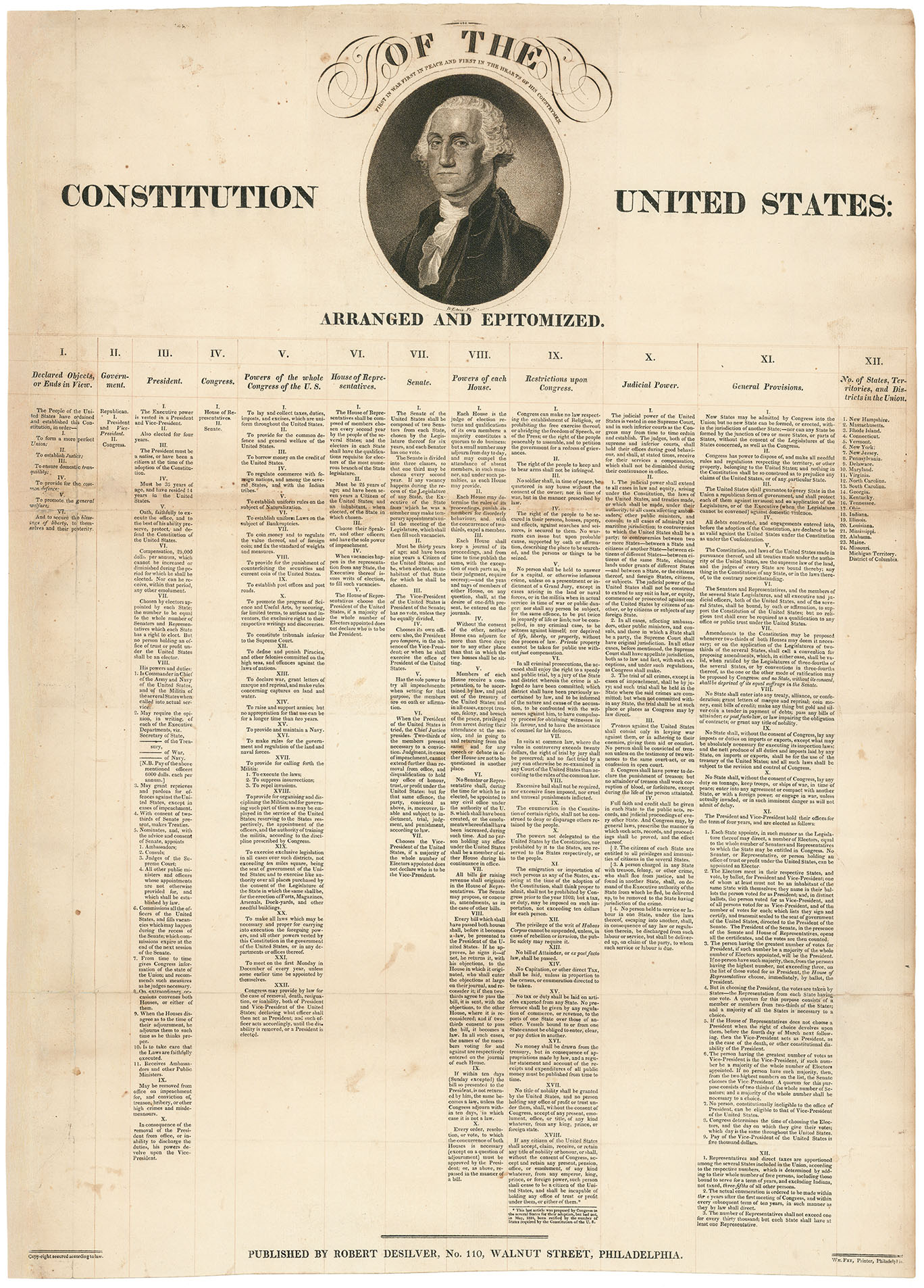
DESCRIPTION: <B>A rare printing of the United States Constitution.</B><BR><BR> "We the People of the United States, in Order to form a more perfect Union, establish Justice, insure domestic Tranquility, provide for the common defense, promote the general Welfare, and secure the Blessings of Liberty to ourselves and our Posterity, do ordain and establish this Constitution for the United States of America." <BR> From Preamble, September 7, 1787. <BR><BR> The Constitution is shown arranged and explained in eleven numbered columns under the headings: I. Declared objects or ends in view; II. Government, III. President; IV. Congress; V. Powers of the whole Congress of the U.S.; VI. House of Representatives; VII. Senate; VIII. Powers of each house; IX. Restrictions upon Congress; X. Judicial power. XI. General Provisions; XII. No. of States, Territories, and Districts in the Union. Twenty-four states are listed, with Missouri, admitted to the Union on Aug. 10, 1821, as the last. Michigan Territory (achieved statehood in 1837) and the District of Columbia are also noted. <BR><BR> Portrait of George Washington: First in War, First in Peace, and First in the Hearts of His Countrymen. Stipple engraving by David Edwin (Hart #360c) based on the painting by Gilbert Stuart.<BR><BR> David Edwin (1776-1841) was born in England, the son of John Edwin, a comic actor, and was apprenticed to an engraver, but he ran away to sea and reached America in 1797. There, he was employed by Edward Savage, the portrait painter and engraver. <br><br> William Fry (1777-1855) was a printer, pressman, publisher, compositor, and proofreader. Publisher of the National Gazette and Literary Register. (1820-41.) Fry was the first to use the newly developed Columbian press. <br><br> Robert Desilver (1779-1837) was an entrepreneurial Philadelphia publisher who became famous for his maps, directories, and almanacs. <br><br> The United States Constitution has served as the supreme law of the United States since taking effect in 1789. The document was written at the 1787 Philadelphia Convention and was ratified through a series of state conventions held in 1787 and 1788. Since 1789, the Constitution has been amended twenty-seven times; particularly important amendments include the ten amendments of the United States Bill of Rights, the three Reconstruction Amendments, and the Nineteenth Amendment. <br><br> <I>The US Constitution and the Organization of the National Government</I> <br><br> The US Constitution created a system of checks and balances and three independent branches of government. <br><br> <b>The Legislative Branch Article I.</b> The Constitution established Congress. The framers of the Constitution expected Congress to be the dominant branch of government. They placed it first in the Constitution and assigned more powers to it than to the presidency. Congress was given "all legislative powers," including the power to raise taxes, coin money, regulate interstate and foreign commerce, promote the sciences and the arts, and declare war. <br><br> <b>The Executive Branch Article II.</b> The Constitution created the presidency. The president’s powers were stated more briefly than those of Congress. The president was granted "executive Power," including the power "with the Advice and Consent of the Senate," to make treaties and appoint ambassadors. The president was also to serve as commander in chief of the army and navy. In delegate James Wilson’s view, the presidency was "the most difficult [issue] of all on which we have had to decide." Americans had waged a revolution against a king and did not want concentrated power to appear in another guise. <br><br> On August 18, 1787, a Pennsylvania newspaper carried a leaked report from the Constitutional Convention. It was the first word on the proceedings that directly quoted a delegate. "We are well informed" of "reports idly circulating," that it is intended to establish a monarchical government. - Tho’ we cannot, affirmatively, tell you what we are doing, we can, negatively, tell you what we are not doing - we never once thought of a king." <br><br> The conflict with royal governors had made the public deeply distrustful of powerful executives. Alexander Hamilton argued for a chief executive with broad powers and elected for life. Edmund Randolph of Virginia thought executive power should not be placed in the hands of a single person, since a single executive would be "the fetus of monarchy." <br><br> To ensure a check on presidential power, Congress was given the power to override a presidential veto and to impeach and remove a president. Congress alone was given the power to declare war. <br><br> <b>The Judicial Branch Article III</b> The Constitution established a Supreme Court. The Constitution does not specify the size of the Supreme Court. Over the years, the designated size of the Supreme Court has varied between six, seven, nine, and even ten members. Nor does the Constitution explicitly grant the courts the power of judicial review - to determine whether legislation is consistent with the Constitution. <br><br> Today, no other country uses judicial review as extensively as the United States. Many of our society’s policies on racial desegregation, criminal procedure, abortion, and school prayer are the product of court decisions. The concept of judicial review was initially established on the state level and in the debates over the ratification of the Constitution. <br><br>
ADDITIONAL INFO: Printed in laid, watermarked paper.
CONDITION: Overall in good condition. Horizontally tri-folded, some toning along folds. Some repair and re-instatement along sheet edges.
REFERENCE: Mitchell sale, 1906, Auction, (Auction rooms of David & Harvey, 1906) Lot 398 "Very rare in this state"



 Login / Register
 Basket