Price: SOLD
SKU: 26491
ARTIST: George Caleb Bingham
MEDIUM: Lithograph,
DATE: 1858-59.
EDITION SIZE: Paper size 21 5/8 x 29 3/4" (54.9 x 75.5 cm).
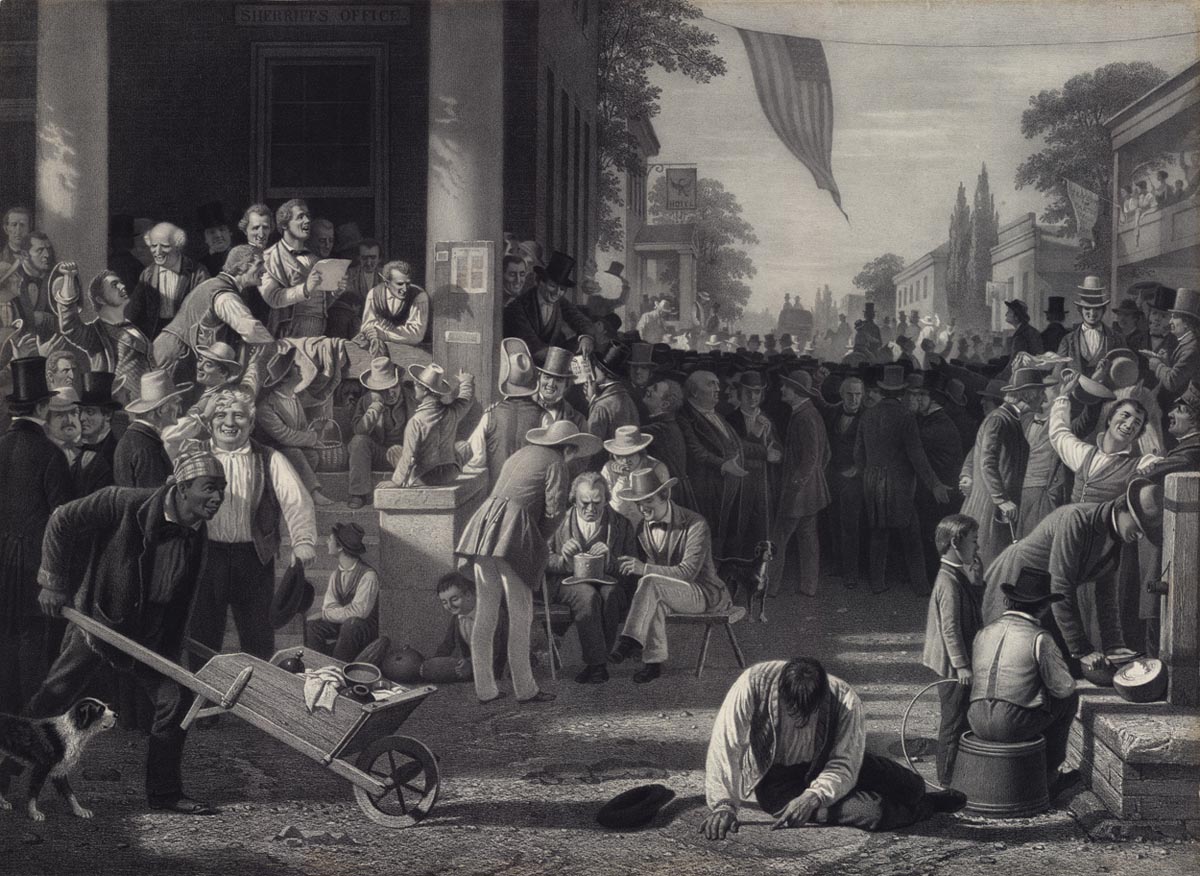
DESCRIPTION: George Caleb Bingham Lithograph, 1858-59. After a painting by George Caleb Bingham. Anonymous German lithographer 1858-59. <BR><BR> E. Maurice Bloch in George Caleb Bingham: A Catalogue Raisonne states that only two impressions of this print are known, both proofs before title. The two known impressions in the 1967 catalogue were in the collection of Mrs. A. S. Colgate of Tuxedo Park, N.Y. now in the Amon Carter Museum in Fort Worth, Texas and in the Estate of Curtis B. Rollins, Columbia, Missouri now in the Missouri Historical Society. Therefore this is the third known impression.<BR><BR> There are two stories as to why this print is so rare. The artist's son, J. R. Bingham, told one version to C. B. Rollins in 1909. According to J. R. Bingham, Goupil was hired to publish the print in 1870 and two proofs were produced and sent to the artist for his approval. By the time the order for 5,000 prints arrived in Paris, the Franco-Prussian War had started and the stone had been destroyed at Goupil's printing studio. <BR><BR> E. Maurice Bloch discovered another scenario. Citing a letter written by George C. Bingham on June 3, 1857, the artist stated that he did not want to sell the publication rights to Goupil but wanted to publish the print for his own benefit. Unable to find a lithographer in Paris, he located one in Dusseldorf, Germany, where he was staying. In August 1858 Bingham indicated that the work was in progress but that there had been some difficulties with the lithographer and the completion of the print had been delayed. It is obvious that the project was eventually finished; however, there was no edition ever printed. <BR><BR> George Caleb Bingham is considered by many to be America's finest genre painter. A number of his printed images have a political theme. Three large prints were produced after his “Election Series” paintings. The first published was the “County Election,” second “Stump Speaking,” and as discussed above “The Verdict of the People” exists in proofs only.<BR><BR> Bingham was sent to the Whig convention at Rocheport, Missouri in 1840. It is believed that at this time he must have realized the artistic possibilities of the political scene and filled his drawing book up with sketches which were later utilized for his large compositions.
ADDITIONAL INFO: After a painting by George Calib Bingham. Anonymous German lithographer 1858-59. E. Maurice Bloch in George Caleb Bingham: A Catalogue Raisonne states that only two impressions of this print are known and both are proofs before title. The two known impressions in the 1967 catalogue were in the collection of Mrs. A. S. Colgate of Tuxedo Park, N.Y. (that impression is currently in the Amon Carter Museum in Fort Worth, Texas) and in the Estate of Curtis B. Rollins, Columbia, Missouri (location of that impression is unknown). There are two stories as to why this print is so rare. The artist's son, J. R. Bingham, told this version to C. B. Rollins in 1909. According to J. R. Bingham, Goupil was hired to publish the print in 1870 and two proofs were produced and sent to the artist for his approval. By the time the order for 5,000 prints arrived in Paris, the Franco-Prussian War had started and the stone had been destroyed at Goupil's printing studio. While doing research, E. Maurice Bloch discovered another scenario. Citing a letter written by George C. Bingham on June 3, 1857, the artist stated that he did not want to sell the publication rights to Goupil but wanted to publish the print for his own benefit. Unable to find a lithographer in Paris, he located one in Dusseldorf, Germany, where he was staying. Bloch later found a notice published in Dusseldorf in August 1858, indicating that the work was in progress but that there had been some difficulties with the lithographer and the completion of the print had been delayed. It is obvious that the project was eventually finished; however, there was no edition ever printed. It is possible that this is the Rollins impression, but I believe that this is the third proof to become available in the last 100 years. It is a wonderful impression generally in good condition. This impression has no margins being trimmed to the image edge. The other two impressions noted by Bloch were proofs before title so there is nothing written in the margins if the Rollins impression had margins. The Colgate/Amon Carter impression had narrow (around 1") margins.
CONDITION:
REFERENCE:



 Login / Register
 Basket