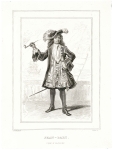
Tony Johannot
Tony Johannot (1803–1852) was a French engraver, illustrator, and painter whose work became central to book illustration during the early to mid-19th century. Born in Offenbach am Main, he came from a family deeply involved in the graphic arts. His father, Francois Johannot, worked in the early development of lithography in France, while his older brothers, Charles and Alfred, were engravers who helped train him. Working alongside Alfred, Tony contributed illustrations to popular editions of James Fenimore Cooper and Walter Scott, building a reputation for lively narrative imagery and refined technique. Though trained in traditional engraving, he gravitated toward wood engraving, which allowed for a more expressive and efficient style suited to mass-produced illustrated books.
By the 1830s Johannot had become one of the most sought-after illustrators in Paris, with his historical and literary subjects shown at the Paris Salon beginning in 1831. His work helped shape the visual language of Romantic literature, including celebrated illustrations for Rousseau, Goethe, and French novelists of the period. Johannot later returned to etching in 1845, continuing to expand his range while maintaining a precise, elegant line. His contributions to 19th-century book arts, and his influential role in elevating the quality of commercial illustration, earned him lasting recognition among French engravers and illustrators of the period.



 Login / Register
 Basket