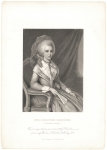
Ralph Earl
An important late-eighteenth-century American itinerant painter, Ralph Earl is recognized as one of the most significant portraitists of the post-Revolutionary era. Best known for his distinctive blending of traditional English academic style with a stark, linear American realism, his career spanned New England, New York, and a formative period of study in London, capturing the likenesses of the emerging political, merchant, and landowning elites of the early republic.
Earl began his artistic career as a self-taught painter in Connecticut, where he famously traveled to Lexington and Concord in 1775 alongside the engraver Amos Doolittle to create early sketches of the opening battlefields of the Revolutionary War. Despite these early patriotic associations, Earl refused to swear allegiance to the American cause due to his Loyalist sympathies. Facing political hostility, he fled to England in 1778, where he spent seven years refining his technique. In London, he entered the studio of Benjamin West and was deeply influenced by the grand manner portraiture of Thomas Gainsborough and Sir Joshua Reynolds. This period introduced a greater sophistication to his handling of paint, drapery, and composition, which he later successfully adapted to American tastes.
Returning to the United States in 1785, Earl established himself as an itinerant master, working extensively in New York and throughout Connecticut, particularly in Litchfield and Fairfield counties. His post-war portraits departed from European idealization, focusing instead on a factual presentation of his sitters, who were routinely depicted surrounded by their material wealth, libraries, and expansive local landscapes seen through open windows. Despite his widespread success, Earl struggled with lifelong financial instability and chronic alcoholism, even executing several major commissions while confined to a New York debtors' prison in the late 1780s. His later years were spent traveling across New England producing portraits and early topographical landscapes until his death in 1801.
References
Kornhauser, Elizabeth Mankin. Ralph Earl: The Face of the Young Republic. New Haven: Yale University Press, 1991.
Miles, Ellen G. American Paintings of the Eighteenth Century. Washington, D.C.: National Gallery of Art, 1995.
Sawitzky, William. Ralph Earl, 1751–1801. New York: The New-York Historical Society, 1945.



 Login / Register
 Basket